
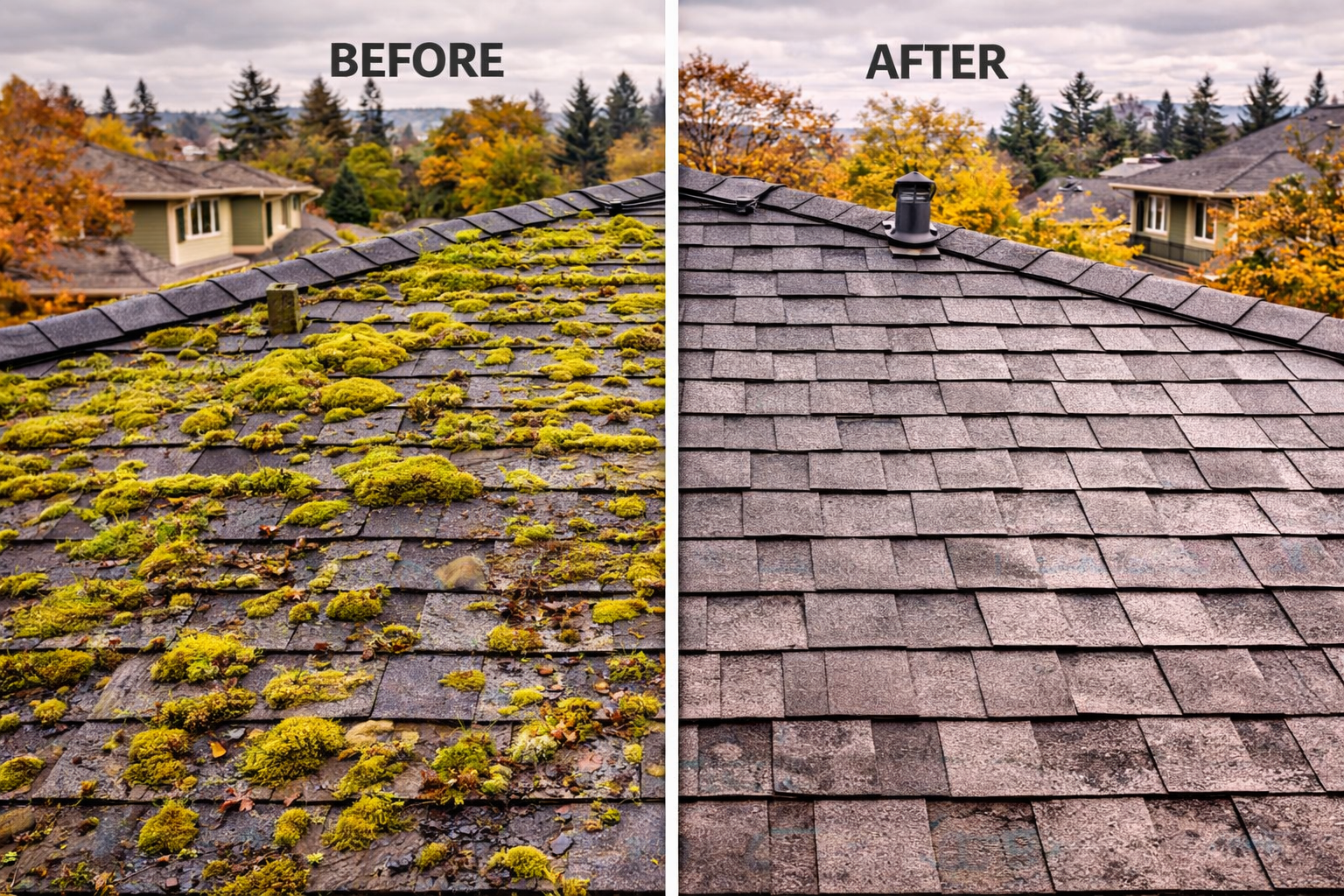
Roof cleaning in Portland, OR involves removing moss, algae, lichen, and organic debris using soft washing and specialized chemical treatments. Portland’s wet, overcast climate accelerates biological growth faster than most U.S. cities, making regular roof maintenance essential for protecting shingles, preventing leaks, and extending roof life by several years.
If your roof is starting to look darker, greener, or streaked with black lines, you’re not imagining things. Portland’s climate creates near-perfect conditions for moss and algae to spread across roofing material year-round. Left alone, that growth doesn’t just look bad. It works its way under shingles, traps moisture, and quietly accelerates structural damage that costs thousands to repair.
Key Takeaways
- Portland’s mild, rainy climate means most roofs need cleaning every 1 to 3 years to prevent damaging moss and algae growth.
- Soft washing with a biodegradable chemical solution is the safest and most effective method for most residential roofs in the Pacific Northwest.
- Pressure washing shingles directly can void manufacturer warranties and strip protective granules, reducing the roof’s remaining lifespan.
- Treating the roof after cleaning with zinc or copper strips can slow moss regrowth significantly over the following years.
- Roof treatments are most effective when moss is actively growing, which typically occurs during wetter conditions, allowing treatments to better absorb and deliver long-lasting results.
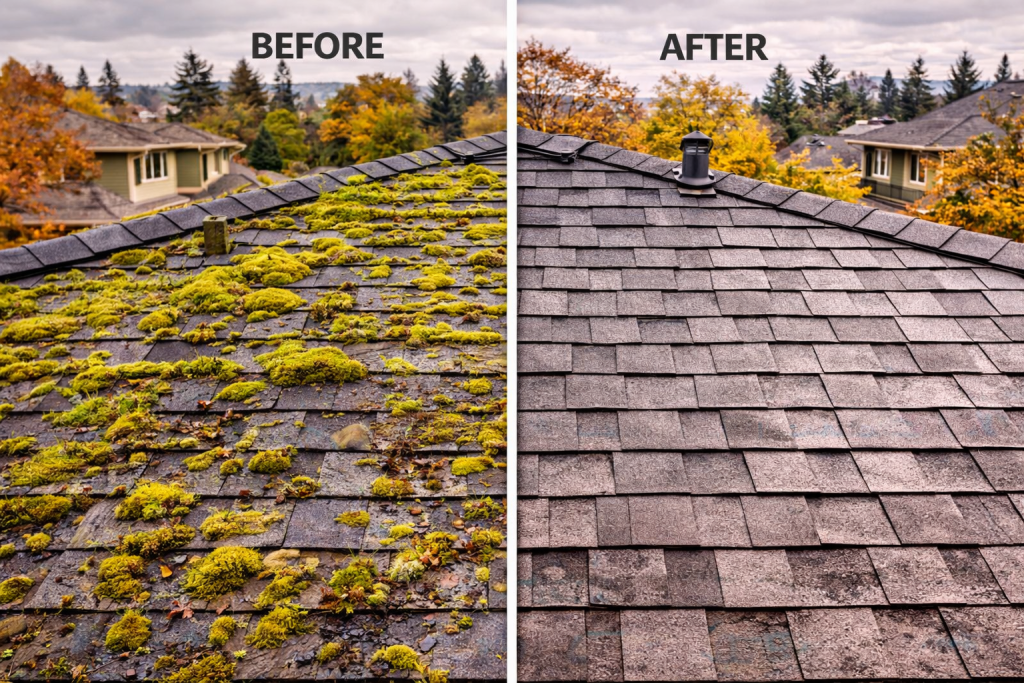
Why Portland Roofs Face More Biological Growth Than Most Cities
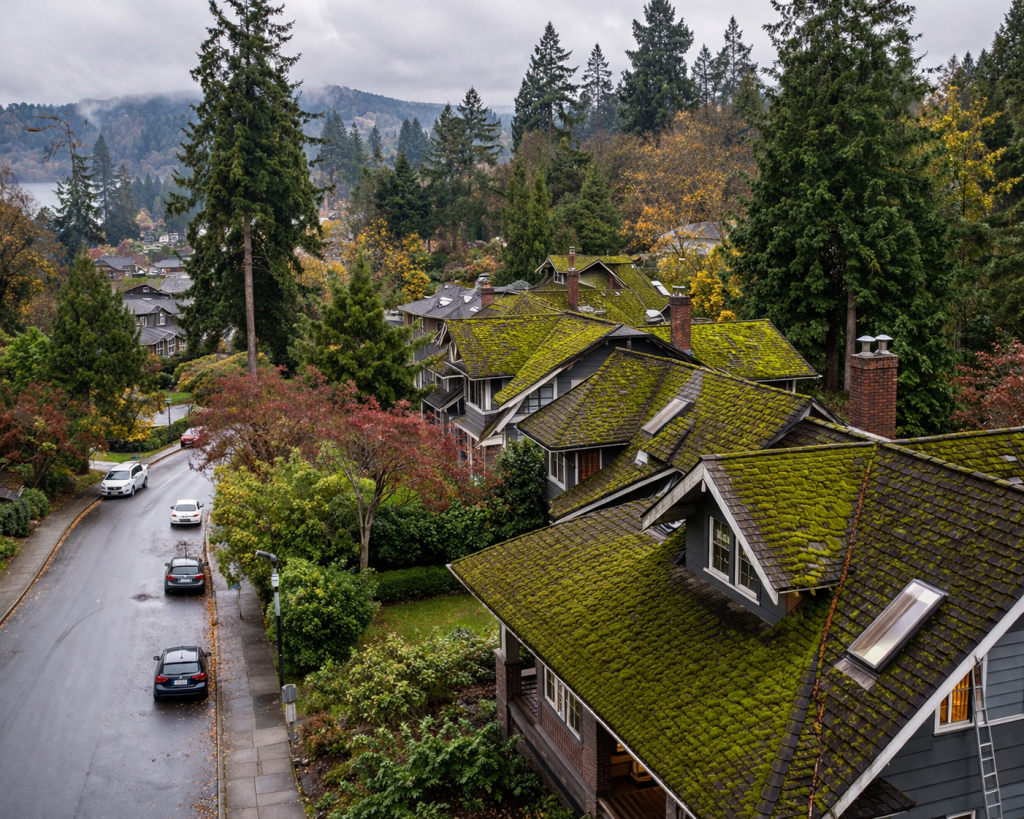
Portland averages roughly 36 inches of rainfall per year, but the bigger factor isn’t total rain volume. The city experiences long stretches of overcast, drizzly weather where rooftops stay damp for days at a time without the UV exposure that kills biological growth in sunnier climates. That sustained moisture combined with organic debris like fir needles and leaves from Portland’s abundant tree canopy, creates a feeding environment that moss and algae thrive in.
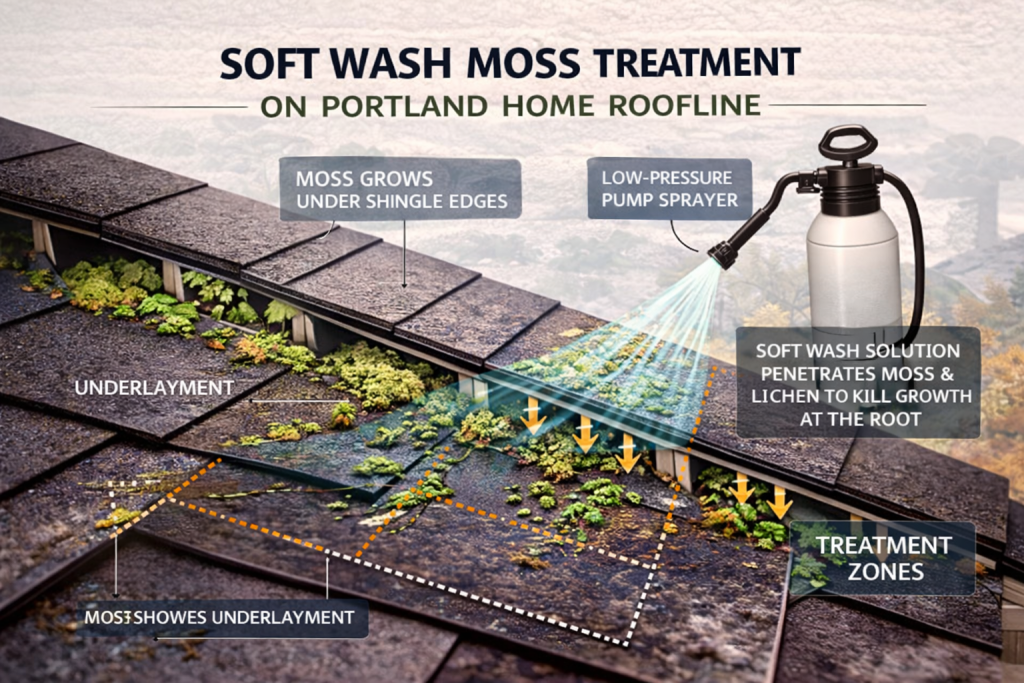
Studies on roofing material degradation show that moss growth can lift shingle edges by as much as a quarter inch over a three-to-five year period, creating gaps that allow water infiltration during heavy rain. Once moisture reaches the underlayment, rot and mold follow quickly in Portland’s climate, where ambient humidity rarely drops low enough to allow natural drying.
North-facing roof planes and surfaces shaded by trees are almost always worse. If you’ve noticed that one side of your roof is significantly darker or greener than the other, shade and reduced drying time are almost certainly the cause. That asymmetry is useful information when scheduling cleaning, since those sections often require a longer chemical dwell time to fully treat established growth.
Soft Washing vs. Pressure Washing: Which Method Is Right for Your Roof?
This is one of the most common points of confusion homeowners encounter when researching roof cleaning. The two methods sound similar but produce very different results on roofing materials.
Soft washing uses low water pressure combined with a cleaning solution, typically a sodium hypochlorite blend with surfactants, applied directly to the roof surface. The solution does the chemical work of killing moss, algae, and lichen at the root level, while the low pressure rinse doesn’t disturb the shingle granules. This is the method recommended by most roofing manufacturers and industry associations for asphalt shingles.
Pressure washing uses high-pressure water to physically blast debris off the surface. While it works quickly and produces immediately visible results, the force strips granules from asphalt shingles. Those granules are the primary UV protection layer for your shingles, and once they’re gone, the underlying mat degrades rapidly.
The Asphalt Roofing Manufacturers Association (ARMA) specifically recommends against high-pressure washing for asphalt shingles and states that low-pressure application of cleaning solutions is the preferred method for biological growth removal. Some shingle warranties explicitly exclude damage caused by pressure washing from coverage.
| Method | Best For | Risk to Shingles | Results Timeline |
| Soft Washing | Asphalt shingles, most residential roofs | Low | Full results in 1-4 weeks as dead growth washes away |
| Pressure Washing | Concrete or clay tile, metal roofs | High for asphalt | Immediate visual results |
| Manual Scrubbing | Spot treatment, small areas | Moderate if aggressive | Immediate but labor-intensive |
| Chemical Treatment Only | Light algae streaks, preventive treatment | Very low | 2-6 weeks, relies on rain to rinse |
Step-by-Step: How Professional Roof Cleaning Works in Portland
- Roof inspection and assessment. A quick inspection is done before cleaning to spot problem areas and make sure the roof is safe to treat.This identifies problem areas, checks for loose or missing shingles that could be worsened by water, and determines the appropriate treatment strength needed based on the level of biological growth.
- Protecting landscaping and surrounding surfaces. On roofs with excessive moss buildup, larger debris is brushed off first before applying the cleaning solution. This helps the treatment reach deeper and work more effectively.
- Applying the cleaning solution. The soft wash solution is applied using a low-pressure pump sprayer from the ridge line downward, ensuring even coverage across all affected sections. On heavily infested roofs, a second pass may be applied after a short dwell time to ensure the treatment penetrates established lichen and thick moss colonies.
- Dwell time and chemical activation. The solution is left to work for a set period, typically 15 to 30 minutes depending on temperature and growth density. This is when the actual killing of biological matter occurs. Rushing this step reduces effectiveness significantly.
- Low-pressure rinse. Once the dwell period is complete, the roof is rinsed with low-pressure water to remove loosened debris and neutralize the cleaning solution. Dead moss and algae continue washing off naturally over the following weeks as rain moves across the roof.
- Post-treatment application (optional but recommended). Zinc or copper sulfate solutions can be applied to the ridge line after cleaning. As rainwater flows over these strips or treatments, it carries trace amounts of the metal down the roof surface, creating conditions that inhibit future moss regrowth for 12 to 24 months.
Common Mistakes Homeowners Make With Roof Cleaning
- Using a pressure washer on asphalt shingles. The immediate visual result is satisfying, but granule loss is irreversible. Even one overly aggressive pressure washing session can reduce a roof’s remaining lifespan by years.
- Applying bleach solution without protecting landscaping. Sodium hypochlorite runoff can burn plants, grass, and soil. Always wet surrounding vegetation and control where runoff flows before starting any chemical treatment.
- Scrubbing moss off manually without killing it first. Scrubbing moss off without treating it first can be less effective, depending on how thoroughly it’s removed.
- Ignoring the underlying cause of heavy growth. If a section of roof grows moss back within six months repeatedly, overhanging branches are usually the culprit. Trimming trees back to allow more sunlight and airflow does more long-term good than repeated cleaning cycles alone.
- Cleaning in winter during heavy rain periods. Roof cleaning can still be done during rainy periods, as solution concentration can be adjusted to maintain effectiveness.
- Waiting until the roof looks terrible. By the time moss is visibly thick and green, it has almost certainly already worked under shingle edges. Cleaning at the first signs of dark streaking or light growth is dramatically easier, cheaper, and less damaging to shingles than waiting until the problem is severe.
Regular preventive roof cleaning and moss treatment has been shown to extend asphalt shingle roof lifespan by an estimated 5 to 10 years compared to roofs left untreated in comparable high-moisture climates. The cost differential between routine maintenance and premature full roof replacement is substantial, often exceeding $15,000 for mid-sized Portland homes.
Addressing moisture-related roof damage early also connects directly to the ability to protect from water damage at the structural level, since the pathway from moss growth to interior leaks is shorter than most homeowners expect.
Areas Around Portland Where Roof Cleaning Is Commonly Needed
The roof cleaning demand across the greater Portland metro follows the tree canopy and rainfall patterns closely. Neighborhoods and cities with heavier tree coverage and reduced sun exposure consistently see faster biological growth on rooftops.
- Portland West Hills — Heavy Douglas fir coverage and north-facing slopes create some of the worst moss conditions in the metro area.
- Lake Oswego and Tualatin — Mature tree canopies and proximity to the Willamette River corridor mean sustained moisture on roof surfaces throughout fall and winter.
- Beaverton and Hillsboro — Newer housing stock in these areas still accumulates algae streaking relatively quickly due to regional rainfall patterns.
- Gresham and Troutdale — Eastern corridor homes near the Columbia River Gorge deal with additional wind-blown organic debris that feeds moss growth.
- Vancouver, WA — Just across the river, Vancouver homes face identical climate conditions and benefit from the same cleaning approaches used in Portland proper.
- Tigard and Sherwood — Suburban neighborhoods with established landscaping see roof moss problems develop at a similar pace to inner Portland.
For homes where roof moss removal is already overdue, a more intensive initial treatment followed by a preventive maintenance schedule is typically more cost-effective than repeated standard cleanings every year.
Frequently Asked Questions About Roof Cleaning in Portland
How often should I clean my roof in Portland?
For most Portland homes with asphalt shingles, cleaning every one to three years is the practical range. Homes under heavy tree canopy or with significant north-facing roof exposure typically need attention every 12 to 18 months. Homes in sunnier, more open locations may stretch to three years between full cleanings, though an annual visual inspection is always worthwhile to catch early growth before it becomes established.
Does soft washing or pressure washing damage shingles?
Soft washing, when done correctly with appropriate pressure and properly diluted solutions, does not damage asphalt shingles. Pressure washing is a different matter. High-pressure water strips the granule coating from shingles, which is the layer that provides UV protection and weatherproofing. Repeated pressure washing significantly shortens shingle lifespan, and some manufacturers will void warranty coverage if evidence of pressure washing is present during a claims assessment.
What is the best way to remove moss from a roof?
The most effective approach combines a biocidal cleaning solution with a low-pressure rinse. The treatment works by killing moss at the root level and eliminating spores that would otherwise spread during cleaning. Pressure washing alone can actually accelerate regrowth by dispersing these spores across the roof surface, leading to faster return of moss. After treatment, installing zinc along the ridge line provides ongoing protection, as it releases trace metals with rainfall that help prevent new moss from taking hold.
What time of year is best to remove moss from a roof?
Moss can be treated year-round, but it’s most effective when the moss is actively growing. Professionals can also adjust treatment strength depending on weather conditions.
What is the white powder people put on their roofs?
The white powder people put on roofs is typically a moss treatment, often zinc- or calcium-based. While these products can help prevent moss from coming back, they are not as effective as sodium hypochlorite when it comes to killing existing moss. They usually take longer to work and often require multiple applications. However, they do perform well as a preventative measure to slow down future moss growth.
Final Thoughts: Don’t Wait Until You Can See the Problem Clearly
Moss and algae on a Portland roof are rarely as invisible as homeowners assume. The dark streaking, the creeping green edges, the patches that seem to reappear every winter, these are signals worth acting on earlier rather than later. The gap between a routine cleaning and a premature roof replacement can be measured in thousands of dollars, and the intervention required to close that gap is surprisingly straightforward when you catch it in time.
Understanding what’s happening on your roof and why it matters in Portland’s specific climate is half the battle. The other half is working with someone who knows local conditions well enough to match the treatment to what your roof actually needs.
Ready to Get Your Portland Roof Cleaned?
Schopp’s Home Maintenance serves Portland and the surrounding metro area with professional soft wash roof cleaning, moss treatment, and preventive maintenance designed specifically for the Pacific Northwest climate. Whether your roof has visible moss growth or you just want an honest assessment before winter, the team at Schopp’s can help you figure out exactly what your roof needs and what it will take to protect it long-term.
Call Schopp’s Home Maintenance today: +1 503-506-4990
