
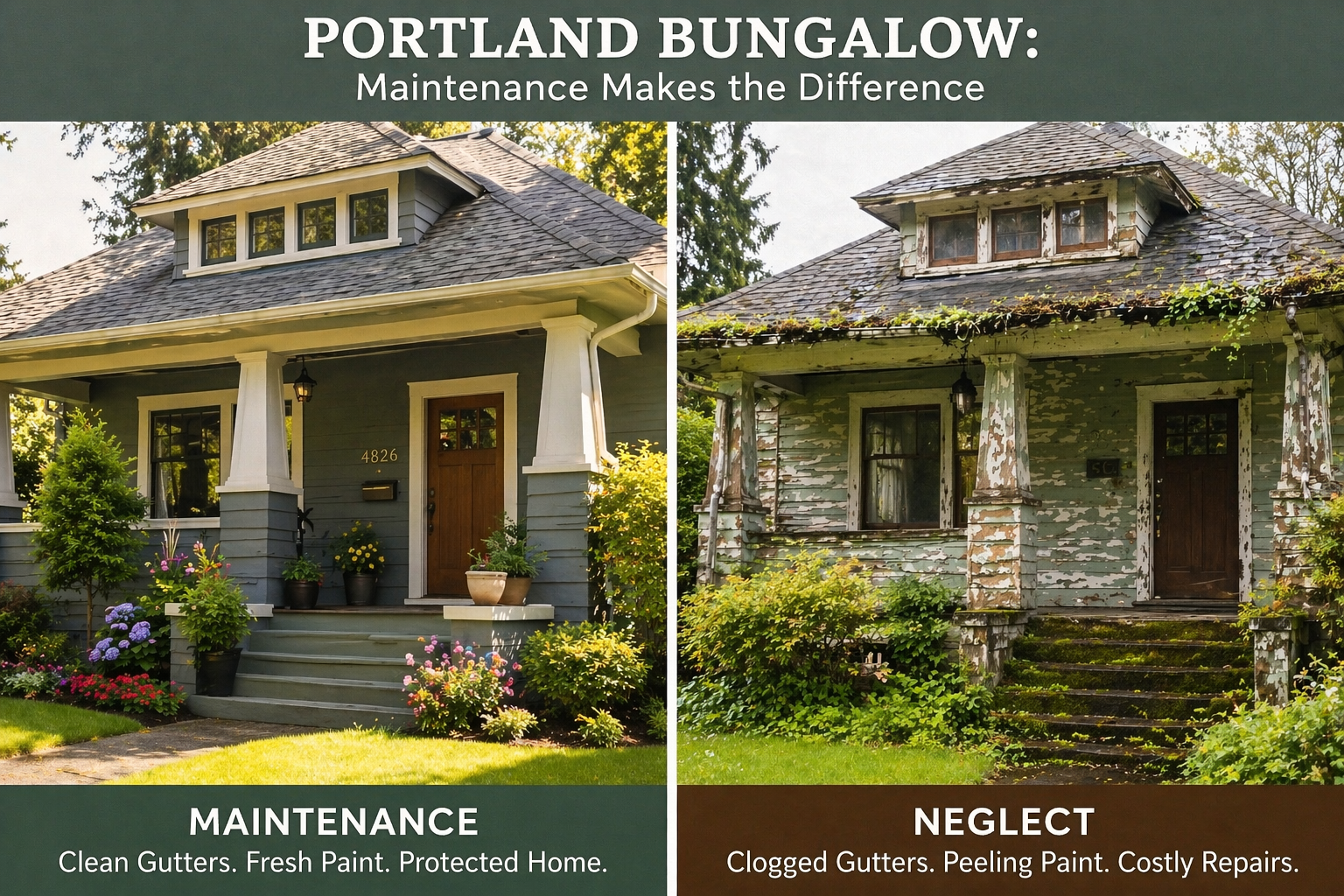
Property maintenance refers to routine, preventive tasks performed on a schedule to keep a home in good working condition, such as cleaning gutters. Home repair addresses something that has already broken down or failed. The distinction matters because maintenance prevents repairs, and mixing up the two often leads Portland homeowners to spend far more than necessary.
Most homeowners notice a problem and immediately call it a “repair.” But a lot of what gets labeled as repair work is actually deferred maintenance. That gap in understanding costs money. In Portland’s wet climate, a missed gutter cleaning in October can turn into a water-damaged fascia board by February. Knowing which category a task falls into changes how you budget, how you prioritize, and how often you take action.
Key Takeaways
- Property maintenance is preventive and recurring; home repair is reactive and addresses existing damage or failure.
- Most home repairs in Portland are the result of skipped or delayed maintenance, not random bad luck.
- Maintenance costs are predictable and budgetable; repair costs are unpredictable and often significantly higher.
- Portland’s rainy season makes exterior maintenance especially time-sensitive for homeowners in the region.
- Some tasks blur the line between maintenance and repair, which is why having a knowledgeable home services provider matters.
- Renovations are a separate category entirely and should not be confused with either maintenance or repair.
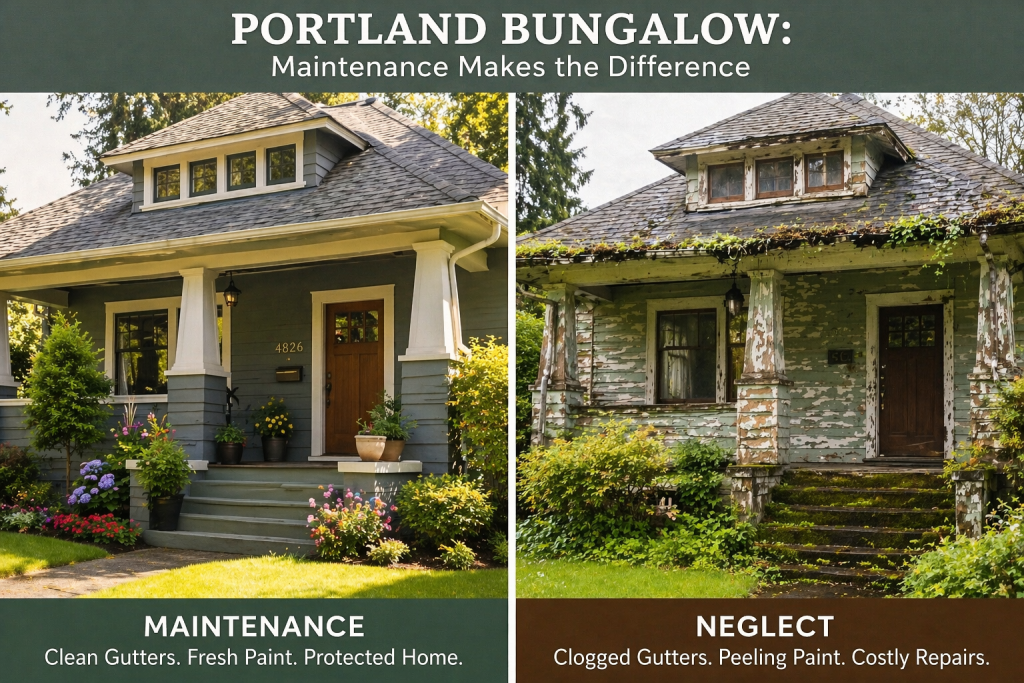
What Exactly Is Property Maintenance?
Property maintenance is the set of recurring tasks you perform to preserve the condition of a home before anything goes wrong. Think of it like oil changes for a car. You do not wait for the engine to seize before changing the oil. You change it on a schedule because you know neglect leads to failure.
These tasks are usually seasonal, annual, or tied to a specific interval. They are not triggered by a problem but by time or condition. For Portland homeowners, the maintenance calendar often revolves around weather patterns: preparing before fall rains arrive, checking drainage systems after winter, and inspecting roofing and siding as summer dries everything out.
Common Property Maintenance Tasks
- Cleaning and inspecting gutters and downspouts (typically twice a year in Portland)
- Servicing the furnace or heat pump before the heating season
- Caulking and weatherstripping around windows and doors
- Checking attic ventilation and insulation for moisture buildup
- Treating wood decks or fences to prevent rot and UV damage
- Flushing water heaters to remove sediment
- Testing smoke detectors and replacing batteries
- Inspecting roof flashing and shingles after heavy storms
None of those tasks fix something broken. They all prevent something from breaking. That is the defining characteristic of maintenance: it is proactive, not reactive. If you want a deeper look at how these tasks change through the year, the guide on seasonal home maintenance in Portland breaks it down month by month.
What Is a Home Repair?
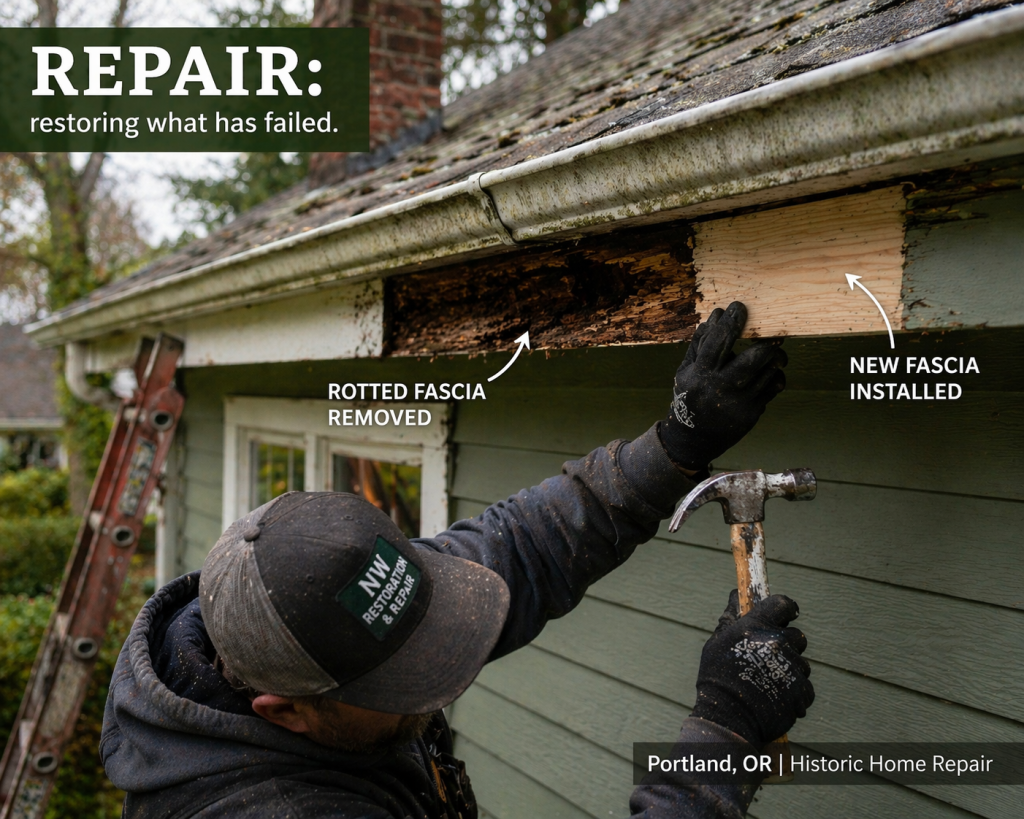
A home repair restores something that has already failed, deteriorated, or broken to its previous functional state. It is reactive by nature. The toilet runs constantly. The window no longer seals. The floorboard buckles after water intrusion. A repair brings the component back to working condition without changing its original form or function.
Repairs are not optional the way maintenance sometimes feels. When something is broken, it usually needs to be addressed promptly to prevent further damage. A leaking pipe does not get better on its own. A cracked foundation does not seal itself.
According to industry estimates, the average homeowner spends between 1% and 3% of their home’s value annually on repairs and maintenance combined. However, homes with consistent preventive maintenance programs trend toward the lower end of that range, while homes with chronic deferred maintenance often exceed it significantly.
Common Home Repair Examples
- Replacing a broken garbage disposal
- Patching drywall after water damage
- Fixing a leaking roof after a storm tears away flashing
- Repairing a cracked sewer line
- Replacing a failed water heater
- Fixing a door that no longer latches due to frame settling
How Do Maintenance and Repair Actually Differ? A Side-by-Side Comparison
The clearest way to see the distinction is to put them next to each other. The table below covers the most important differences across several dimensions that matter to homeowners.
| Factor | Property Maintenance | Home Repair |
| Trigger | Schedule or season | Failure or visible damage |
| Goal | Prevent deterioration | Restore function |
| Timing | Proactive, planned | Reactive, often urgent |
| Cost predictability | High — budgetable | Low — unpredictable |
| Homeowner control | High | Low — circumstances dictate |
| Portland relevance | Rain prep, roof checks, gutter service | Storm damage, water intrusion, rot |
Where Portland’s Climate Changes the Equation
Portland receives an average of 36 inches of rainfall per year, with the majority concentrated between October and March. During those months, unmaintained drainage systems, rooflines, and exterior caulking are under sustained stress. Homes in Portland and surrounding areas like Beaverton, Gresham, and Lake Oswego commonly develop rot, mold, and water intrusion when maintenance schedules are skipped even one season.
That rainfall pattern is exactly why maintenance timing is so critical here. What a homeowner in Phoenix might get away with skipping, a Portland homeowner cannot. Exterior wood deteriorates faster. Gutters fill with debris from the Pacific Northwest’s heavy tree canopy. Roof systems face months of standing moisture rather than brief storms.
For those interested specifically in preparing before the cold and wet sets in, the resource on winter home maintenance covers what Portland homeowners should be doing before November arrives.
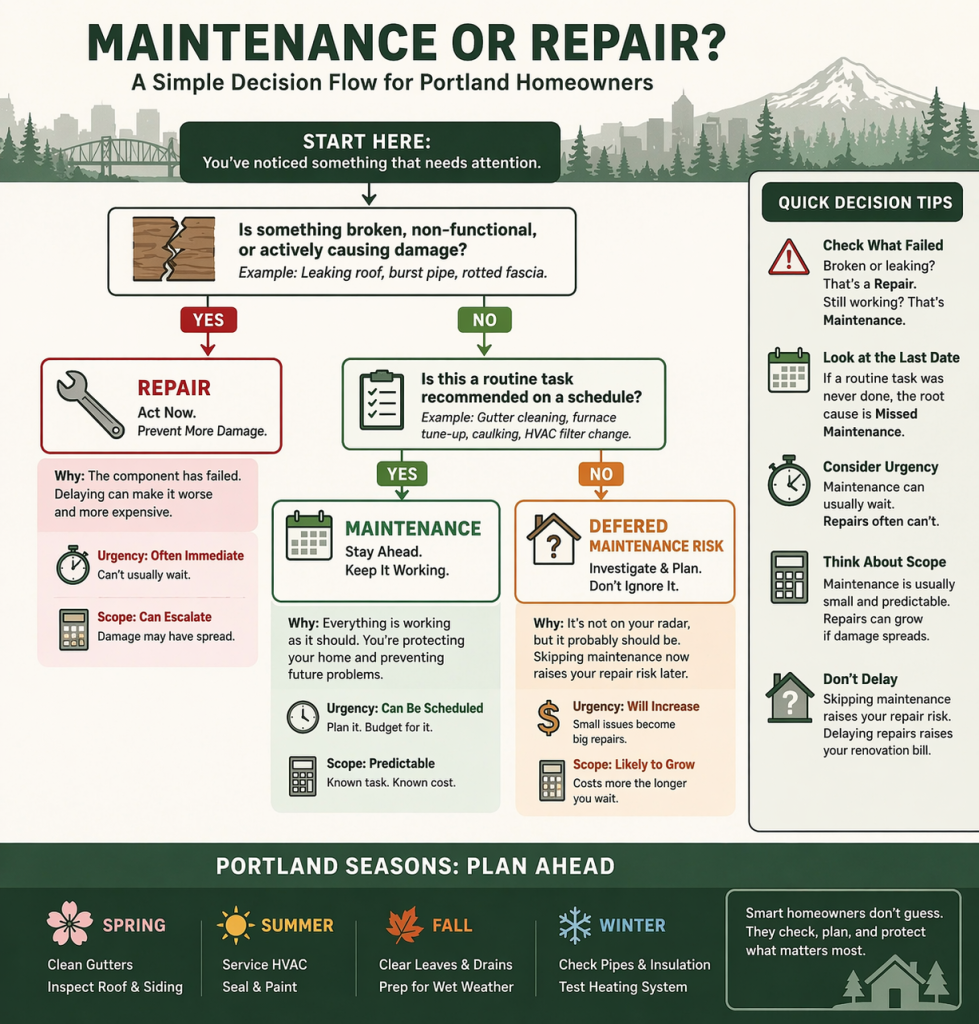
Step-by-Step: How to Decide Whether a Task Is Maintenance or Repair
When something comes up with your home, this decision process helps you categorize it quickly and respond appropriately.
- Ask whether something has failed. If a component is broken, non-functional, or actively causing damage, it is a repair situation. If everything is working but you are acting to keep it that way, that is maintenance.
- Check when the task was last done. If you are finding a problem because a routine task was never completed, the root cause is missed maintenance, even if the fix itself is a repair.
- Assess urgency. Maintenance tasks can usually be scheduled in advance. Repairs often cannot wait. A blocked gutter can be scheduled. A burst pipe cannot.
- Estimate scope. Maintenance tasks are typically bounded in scope and cost. Repairs can escalate depending on how long a problem went unaddressed.
- Consider what happens if you delay. Skipping maintenance raises your repair risk. Delaying a repair raises your renovation cost, because damage compounds over time.
What About Renovations? Where Do They Fit?
Renovations are a third category that homeowners frequently blur with the other two. A renovation or improvement upgrades a home beyond its original condition. It changes function, appearance, or value in a meaningful way. Installing a new kitchen layout, adding a bathroom, or converting a basement into a livable space are all renovations.
| Category | Definition | Example |
| Maintenance | Preventive, recurring | Annual gutter cleaning |
| Repair | Reactive, restorative | Replacing rotted fascia |
| Renovation | Improvement, value-adding | Full deck rebuild with new layout |
Understanding this matters for budgeting and for insurance purposes. Homeowner’s insurance generally covers sudden, accidental damage, not deterioration from deferred maintenance. A roof leak caused by a falling tree is likely covered. A roof leak caused by missing shingles that were never replaced probably is not.
Insurance industry data suggests that a significant percentage of homeowner claims are denied or reduced due to evidence of pre-existing maintenance neglect. Insurers increasingly inspect for signs of deferred upkeep before paying out on claims related to water damage, structural issues, or roof failures.
Can Routine Maintenance Actually Reduce What You Spend on Repairs?
Studies in facilities management and residential property care suggest that every dollar spent on preventive maintenance saves between $3 and $5 in future repair costs. While this ratio varies by property type, climate, and home age, the principle is consistent: proactive spending reduces reactive spending.
For Portland homeowners specifically, consider what an annual deck inspection and treatment prevents. Left untreated, a deck in Portland’s wet climate can develop significant rot within three to five years. A partial deck repair typically runs into the thousands. Full deck replacement runs considerably higher. Proper deck repair maintenance in Portland is one of the clearest examples of where the math strongly favors maintenance over repair.
Common Mistakes Portland Homeowners Make With Maintenance and Repairs
- Treating maintenance as optional. In Portland’s climate, exterior maintenance is not a luxury. Skipping a year of gutter service or deck treatment can produce damage within a single rainy season.
- Confusing a cosmetic issue with a structural one. Peeling paint on siding looks minor but can indicate moisture intrusion behind the surface. Getting a professional assessment before assuming it is cosmetic can prevent a much larger repair.
- Waiting for something to fully fail before addressing it. Small signs of wear, such as slight roof granule loss or a slowly draining sink, are signals to act, not to monitor indefinitely.
- DIY-ing repairs beyond skill level. Homeowners taking on plumbing or electrical repairs without the appropriate knowledge often create secondary damage that makes the original repair more expensive.
- Not keeping records. Without documentation of when maintenance was performed and by whom, it is very difficult to identify patterns, prove work was done, or prepare for a home sale.
- Bundling renovation costs into repair budgets. Homeowners often start with a repair and scope-creep into a renovation without adjusting their budget expectations accordingly.
Nearby Areas We Serve Around Portland
Schopp’s Home Maintenance works with homeowners across the greater Portland metro area. Whether you are in Beaverton, Lake Oswego, Tigard, Gresham, Hillsboro, Tualatin, or Vancouver just across the river, the same principles of proactive maintenance apply. Each neighborhood has its own mix of housing stock, many of which are older craftsman and ranch-style homes that benefit enormously from consistent upkeep programs rather than repeated reactive repairs.
Frequently Asked Questions
What are some examples of property maintenance?
Property maintenance includes tasks like cleaning gutters, sealing windows and doors before winter, treating wood surfaces annually, flushing the water heater, testing smoke detectors, and inspecting the roof after storms. These are recurring tasks performed on a schedule to prevent deterioration rather than to fix something already broken.
What are some examples of home repairs?
Home repairs include fixing a broken garbage disposal, replacing a failed water heater, patching drywall after water damage, repairing a leaking pipe, fixing a door that no longer closes properly due to frame settling, and addressing rot in exterior wood. The common thread is that something has already stopped working or has been damaged, and the repair restores it to functional condition.
Why is it important to distinguish between the two?
The distinction affects how you budget, how urgently you act, and whether your homeowner’s insurance covers the work. Insurance typically covers sudden accidental damage, not deterioration caused by skipped maintenance. From a cost standpoint, maintenance is predictable and manageable while repairs are unpredictable and can escalate quickly if left unaddressed.
Can maintenance save money on repairs?
Yes, substantially. Industry research consistently shows that preventive maintenance reduces repair costs over the long term, often by a ratio of several dollars saved per dollar spent. In Portland specifically, where rainfall and moisture exposure accelerate deterioration of exterior surfaces, consistent maintenance can prevent the kind of compounding damage that turns a small issue into an expensive repair.
What is the difference between repairs and renovations (improvements)?
A repair restores a component to its original functional state. A renovation improves upon or changes the original. Replacing a broken window with the same type is a repair. Installing larger windows with upgraded glazing to improve energy efficiency is a renovation. The distinction matters for tax purposes, insurance, and budgeting, as these categories are often treated differently across all three.
Final Thoughts: Maintenance Protects Your Investment, Repairs Protect Your Home
The most expensive home repairs in Portland are rarely surprise events. They are the end result of maintenance tasks that were skipped one season, then another, until a manageable problem became an urgent one. Understanding the difference between maintenance and repair is not just semantic. It directly shapes how you plan, how much you spend, and how long your home holds its value.
If you own a home in Portland and you are not sure whether you are looking at a maintenance need or a repair situation, getting an expert assessment before things escalate is always the smarter move. Schopp’s Home Maintenance helps Portland homeowners build and execute maintenance programs that catch problems early, handle repairs before they compound, and keep homes in strong condition year-round. Give them a call at +1 503-506-4990 to schedule an assessment or talk through what your home needs this season.
